

Memorial Groves
“Whatever may come or now be made of our Camp Logan, we never can escape the fact that once upon a time… the very heart of our nation beat within this sphere.”
– Ilona B. Benda,1923
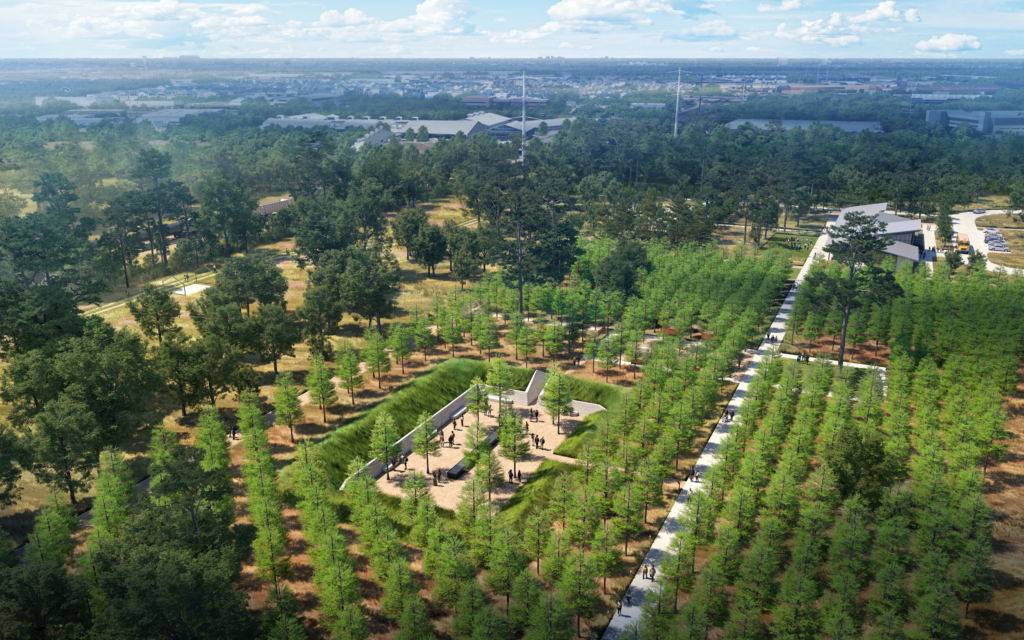
Established in 1924, Houston’s Memorial Park was named to honor the 70,000 soldiers who served at Camp Logan, a U.S. Army training camp during World War I (WWI). The Park’s creation was driven by a campaign from Houstonians, led by Ilona B. Benda, Ima Hogg and Catharine Mary Emmott, to “remember the boys” by acquiring the site and transforming it into a public park.
Will and Mike Hogg, with minority owner Henry Stude, bought two tracts of the former Camp Logan land and sold the acreage to the City of Houston at cost. In May 1924, the City officially established Memorial Park in memory of the soldiers. Today, approximately 1,500 acres of the original 7,600-acre training camp comprise Memorial Park.
About Memorial Groves
Now, more than a century later, Memorial Groves will honor all who contributed to the war effort at Camp Logan. This includes those who trained there, such as the U.S. Army’s 370th Infantry Regiment and the Cavalry, the local organizations that participated in camp life, like the YMCA, as well as the 24th Infantry Regiment, who oversaw construction of the camp.
Accelerated by generous support from Kinder Foundation ($10 million), John L. Nau III ($7.5 million), Brown Foundation ($7.5 million), and the Jerold B. Katz Foundation ($7.5 million), this $50.5 million project is the latest of several transformative improvements envisioned by the Memorial Park Master Plan for the revitalization of Houston’s largest urban greenspace.
Through their design for Memorial Groves, Nelson Byrd Woltz Landscape Architects will create a place-based, interactive experience that not only honors Houston’s World War I history but also serves everyday park users.
Memorial Groves is located on a narrow tract within Memorial Park running north to south primarily between the Union Pacific rail line and West Memorial Loop Drive. This site was chosen because it holds the greatest number of archaeological remains from Camp Logan structures within the Park, providing an opportunity to convey the scale and scope of Camp Logan’s footprint as well as its legacy.
Visitors will learn about the lives and daily routines of the camp’s soldiers as they view the unearthed foundations of camp buildings that lie between two important native habitats: an existing prairie, which will be protected and preserved, and a twenty-acre expanse of savanna habitat that will be restored as part of the project.
A Living Memorial
The design of Memorial Groves seeks to create a living remembrance: a forest of nearly 3,000 bald cypress trees planted in a rigorous grid. Symbolizing soldiers standing in formation, the grid of trees will form long lines, their straight columnar trunks creating tall cathedral-like spaces over time.
Covering twenty continuous acres along both sides of West Memorial Loop Drive, interrupted only by the regular rhythm of the open lawns marking Camp Logan’s historic streets, the groves of trees will provide a palpable sense of the scale of Camp Logan where 70,000 soldiers trained for war.
As the bald cypress change colors with the seasons, visitors immersed within the groves, whether walking its paths or driving along Memorial Loop Drive, will be reminded of the soldiers and their sacrifice, while being inspired by the beauty of the natural cycles of life and renewal.
A new Visitor Center designed by Moody Nolan will anchor the north end of Memorial Groves and will include offices for Memorial Park Conservancy. At the south end, a picnic pavilion, lawn area and playground will become a popular destination for families. Both areas will include new parking and restrooms.
Interpretive features, signage, and exhibits distributed throughout the Memorial Groves landscape and Visitor Center will engage both visitors and everyday Park users with the history of Camp Logan and the stories of individual soldiers who trained there, . The center will also tell the stories of those who supported the camp, from the laborers who built the camp to the soldiers of the 24th Infantry Regiment who guarded its construction.
Enriching the Park User Experience
As with all other Master Plan projects, Memorial Groves will introduce new spaces for recreation and fitness, including trails for walking and cycling, adult workout areas, open lawns for play and picnicking, and a large playground with an adjacent covered pavilion. The playground will create a place where children can play and explore history simultaneously through age-appropriate themes animating a variety of play structures with elements of Camp life.
The playground will offer a one-of-a-kind experience where all ages and abilities can engage directly with the history of the Park through a series of unique play features, detailed by Earthscape, a custom playground company. Kids can climb up and into oversized soldiers’ helmets, army crates, and an enormous loaf of ‘hard bread’ each inscribed with insignias from WWI era. Another series of features includes a large bugle that appears to have blown over the adjacent log scramble and doubles as a talk tube for audio play. The playground is located near the new picnic pavilion and restroom, convenient to the new south parking lot, and nestled within existing trees for shade and comfort.
Seymour Lieberman Trail Enhancements
Significant enhancements will be made to (SLT) within the Memorial Groves project area, as was done in the Eastern Glades and Land Bridge projects. Approximately .7 miles (3,600 ft.) of the trail will be shifted further from West Memorial Loop Drive allowing Groves trees to be planted between the trail and the road. As the trees grow in, the result will be a more scenic and shaded route along the SLT, with the Camp Logan Historic Street Lawns extending across the road at regular intervals providing new grassy areas along the trail for gathering, stretching or resting adjacent to new fitness stations.
Memorial Groves Visitor Center
The new visitor center will anchor the primary entrance to the memorial landscape and will educate visitors on the story of WWI, Camp Logan and Memorial Groves. Designed by Moody Nolan, the structure creates a generous breezeway between the main exhibit space and new MPC offices, providing a welcoming threshold to the Groves beyond. The architectural materials and forms are shaped by the local climate, the Park’s architectural traditions, and a desire to bring in natural light and views to the landscape, allowing visitors to feel part of the environment indoors and out. Interpretive design and content of the interior space is spearheaded by Gallagher & Associates, in collaboration with project design lead Nelson Byrd Woltz Landscape Architects (NBW). New Camp Logan historic markers at select entry points to Memorial Groves and the Park will be provided by Texas Historical Commission and included in THC’s official statewide marker database.
Fulfilling the Vision of the Park’s Founders
When completed, Memorial Groves will be a unique, engaging and interactive memorial landscape connecting visitors to the diverse, complex, and untold history of Camp Logan; the role of Houston in WWI; and the lives and sacrifices of the soldiers who trained there. All will understand why the Park is fittingly named Memorial Park.
Construction is slated to begin in 2026, with project completion late 2027.
About the Ten-Year Plan
Memorial Groves is one of several Memorial Park Master Plan projects to be delivered on an accelerated schedule known as the Ten-Year Plan, made possible by a catalyst gift from Kinder Foundation and support from other generous donors. Both the Master Plan and its accelerated Ten-Year Plan projects promote connectivity and resiliency, restore damaged ecologies to provide higher function for the Park and city, help manage storm water, provide new cultural and recreational amenities, and tell the historical narratives of the people and the land through landscape design.
Memorial Park Conservancy is delivering the Ten-Year Plan projects with its project partners: Houston Parks and Recreation Department, Uptown Houston, and Kinder Foundation. Other completed Ten-Year Plan projects include the 100-acre Clay Family Eastern Glades (opened July 2020); the Sports Complex (opened October 2020); a one-mile segment of the Seymour Lieberman Trail that is now off of Memorial Drive and is an exciting run through the trees and over ravines (opened October 2022); the 100-acre Kinder Land Bridge and Cyvia and Melvyn Wolff Prairie (opened February 2023); and the Running Complex (opened November 2023).
Ten-Year Plan Project Partners:
Memorial Park Conservancy
Houston Parks & Recreation Department
Uptown Houston
Kinder Foundation
Master Plan Design and Project Landscape Architect: Nelson Byrd Woltz Landscape Architects
Project Team:
Blackland Collaborative
Dally + Associates
Design Distill
Todd Watson, PhD
Jeffrey Sammons, PhD
English + Associates Architects
Gallagher & Associates
Gandy2 Lighting Design
Gray & Pape, Inc
Jensen Hughes
Minor Design
Moody Nolan
Studio Pacifica
SiteWorks
Teliosity
Tellepsen
Texas Environmental Irrigation Design
Memorial Groves Public Information Sessions:
Memorial Park Conservancy, along with project partners, held two public information sessions for the Memorial Groves project. These information sessions provided the design team with important feedback and the opportunity to address questions and concerns during the development of the design.
The initial session, held on September 10, 2024, introduced the public to the history of the Park and the project’s conceptual design. The second meeting, which took place on February 13, 2025, presented the project’s schematic design.
Attendees were encouraged to ask questions at each session, and both discussions were fully recorded and made available online.
Click here to watch.
Submitting Questions about the Project:
Designers and stakeholders involved in the Memorial Groves project are eager to hear your thoughts and inquiries. Your input is valuable and will contribute to gathering essential public feedback to help inform the project’s design. Please submit any questions and comments via email to groves@memorialparkconservancy.org.
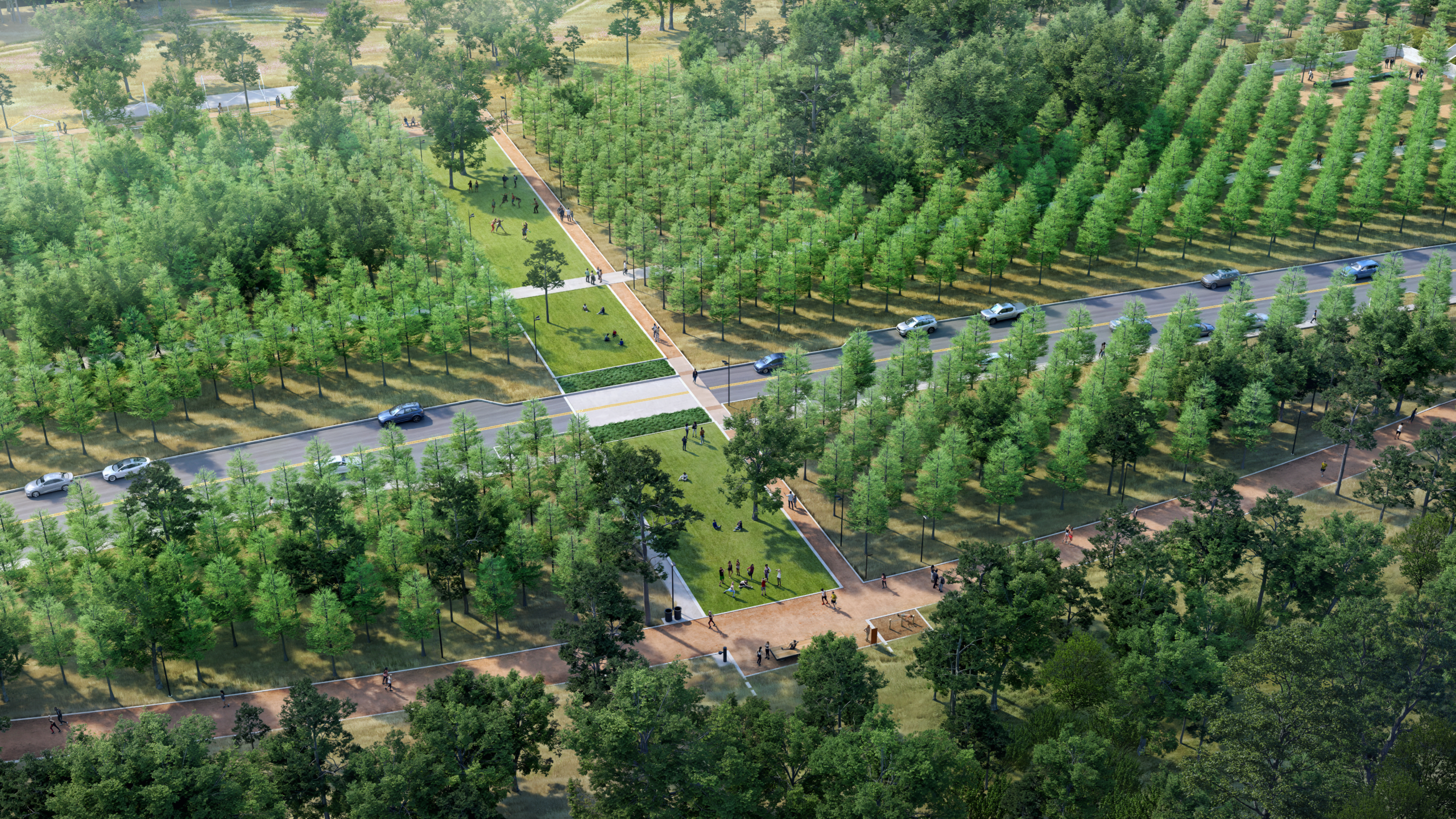
Seymour Lieberman Trail Enhancements within Memorial Groves; Courtesy of Nelson Byrd Woltz Landscape Architects
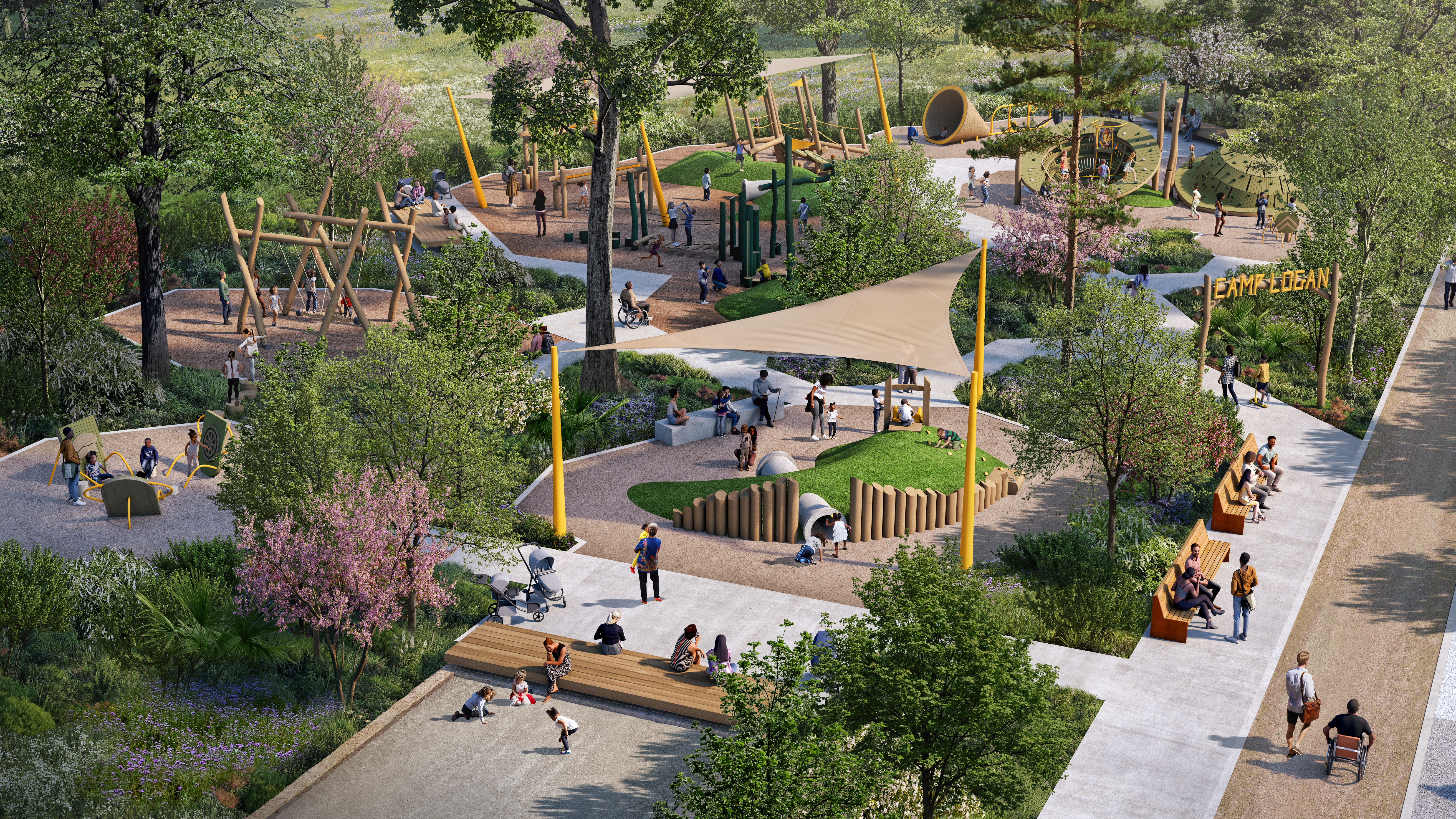
Memorial Groves Playground, south view; Courtesy of Nelson Byrd Woltz Landscape Architects
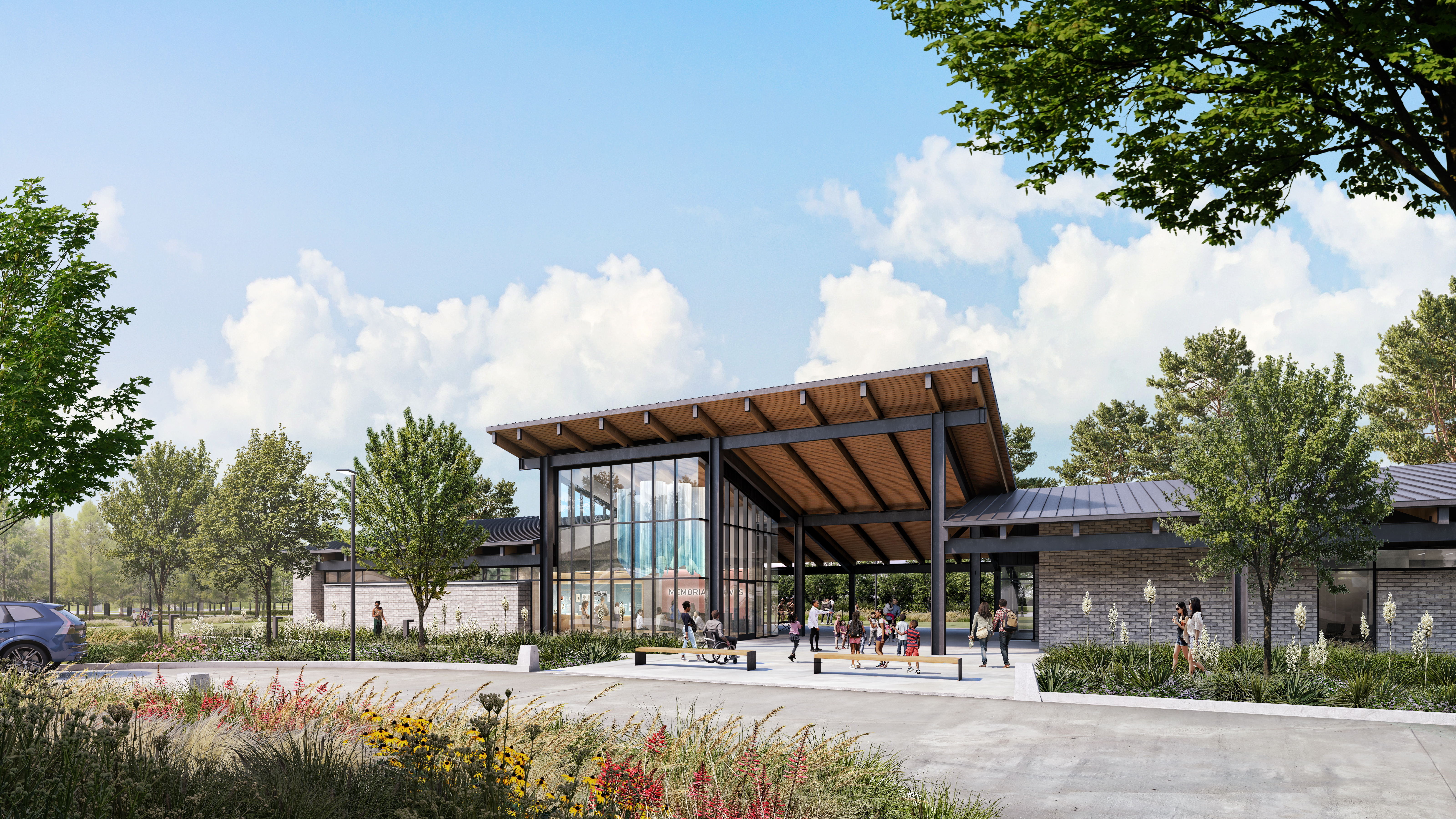
Memorial Groves Visitor Center, Entry View; Courtesy of Nelson Byrd Woltz Landscape Architects
Questions about Memorial Groves: As part of the Memorial Groves public engagement process, the Memorial Park Conservancy, in collaboration with project partners, has invited the community to submit their inquiries regarding the Memorial Groves project. These questions, along with their corresponding answers, have been made available online here. If you have additional questions, please email groves@memorialparkconservancy.org.
The site has been surveyed, and the project team has walked the site numerous times to identify plants and trees to protect biodiversity. Most of the understory plants to be removed are invasives and will be replaced with native plants. Trees to be removed for the proposed structures, paths and parking areas will not be finalized until later in the design process.
While there are many species we may not be fully aware of, the goal is to begin with an initial thinning of the overgrown woody species. This includes both invasive and native species, particularly aggressive ones like Dewberry, which has some sizable examples present, along with invasive Tallow and Ligustrum species. Additionally, we aim to thin out smaller pines and other understory plants to improve visibility and restore the native savanna ecosystem. Savannas are defined by a diverse community of grasses, flowers, shrubs, and trees, featuring a moderate coverage of shrubs and trees. Scattered throughout are clusters of pines and hardwoods, referred to as “motts,” which come in various sizes and create an understory rich in native grasses and forbs. Like forests and prairies, these ecosystems are home to a wide range of insects, reptiles, birds, and mammals. However, maintaining some of the smaller native trees is crucial for ensuring age diversity in the ecosystem over time. At this stage, we still do not have complete knowledge of all the species present.
To accommodate people, paths, and universal access, some disturbance will have to happen. MPC and the design team have focused on the least destructive approach in balancing necessary improvements with the preservation of ecologically valuable trees and understory plants
The plan for Memorial Groves has evolved from the original idea in the Master Plan concept in a number of ways:
- New parking lots were moved to more open and already disturbed locations with low-ecological value and to impact fewer trees
- Type of tree has changed from Pine to Bald Cypress to provide greater resilience
- The number of paths were reduced
- The area for the groves of trees was reduced to allow for savanna restoration
- Inter-planting new trees into existing mature trees
Mature trees will be preserved within the groves areas. The design has evolved since the master plan concept. Based on public feedback and on-site surveys, the groves area has been limited to enable the restoration of 60 acres of savanna. Savanna ecology is endemic to this part of Texas and, like in other projects at Memorial Park, is designed and maintained to thrive. Oaks, Elms, and Cedars, to name a few, are a part of this ecology and are being preserved throughout Memorial Groves.
- The growth of the Bald Cypress that are to be planted in the groves can grow an average of 4-6” per year. Dr. Creech – world renowned for his research on cypress hybrids and our consultant on the project provided this number with the caveat that that growth will vary depending on the conditions – soil, rain, storms, sun, and shade. These trees generally live 600 years, but some can live over 1,000 years.
The intent is to use irrigation for establishment purposes only by selecting native plant species that will thrive in the conditions present on site.
First, to avoid any misunderstanding, it should be noted that the soldiers who trained at Camp Logan did not die here, they fought in trenches overseas to preserve our freedom here.
This design was approved unanimously by Houston City Council in 2015, with input from thousands of Houstonians.
Yes, we believe that the design will honor the soldiers who trained here because it will create a space where their stories can be told, their individual lives and collective sacrifice remembered, on the very ground where they lived and trained. People will be able to get a palpable sense of what their life was like as they prepared to go off to war, and they will be remembered and appreciated for their sacrifice.
We acknowledge that not everyone will agree. There will always be differences of opinion about projects in the public realm and we endeavor to listen respectfully and learn from all the different voices and opinions. The Master Plan started with a year-long public engagement period before the design team set pencil to paper.
What we learned was that along with the goals of enhancing the park’s recreational amenities, making the park more resilient through diverse ecologies, making access to the park easier and safer for people of all abilities, was that there was support creating spaces – not merely objects – where people could come together to honor and share in our collective history by learning why the park was created, and why it matters for us today.
With this project, we have continued to seek input and have had numerous workshops and discussions with a diverse group of community members about the stories that are held here within the land that is now Memorial Park. We have also sought input from community members and stakeholders whose primary interests and expertise are in protecting habitats and maintaining resilient, biodiverse native ecologies.
We believe this project balances all these interests with beauty and dignity and that all Houstonians, whether jogging along a trail, picnicking with friends or family, or visiting from another city or country will come to understand something significant about Houston, our history and our collective humanity within the natural world.
During the February 13th Public Information Session, the Conservancy outlined the number of acres that will be impacted. But a reminder, the project area is not being “cleared.”
Within the 100-acre project site:
- 60 % of the landscape will maintain its native ecology: prairie, savanna and woodland
- 20% will encompass the newly planted groves
- Importantly, the mature trees within the two above areas will be preserved.
- 20% will consist of developed areas (trails and paths, lawn, parking, structures, and native horticulture)
The project elements have been carefully sited to preserve, mature, healthy, non-invasive trees.
Some trees will inevitably need to be removed for paths, parking areas and new structures, but these elements have been sited to minimize impact.
Out of 100 acres the project has allotted 1.43 Total acres for parking including ADA parking and access.
The scale of the project and its siting within the Park are inextricably bound to the size and location of Camp Logan itself. Many of the camp structures, drainage ditches and networks of streets were located here, alongside and because of the railroad, and not elsewhere, and are still discernible through visible archeological features. Visitors and park users will know “I am walking where they walked” and will hear the stories from Camp Logan history that still resonate today. It would be difficult to provide this impactful experience if the project were relocated to another area or limited in its extents.
These creatures have adapted alongside the prairie ecosystem amidst various disturbances. Additionally, there are numerous green spaces available, allowing them to move to different areas and then return. We are particularly enthusiastic about the savanna restoration, as it is expected to enhance wildlife populations. Observations at the Houston Arboretum and Nature Center, including bird counts, indicate that we will see increased biodiversity in this area. As mentioned earlier, these changes occur rapidly, which is one of the main objectives.
Currently, the native plants in this area of the park are getting a lot of pressure from non-native invasive plants. This project will work to manage those invasives and establish a more diverse palette of plants in multiple habitats attractive to native wildlife species
- creating more prairie space, more natural habitat, which will lead to a positive impact on wildlife
- we have the same contracted team who did Eastern Glades and Land Bridge and Prairie, and there has been an overall positive impact on wildlife
Healthy trees above 6” caliper inches in the area have been surveyed, and healthy native trees that are greater than 10” caliper inches will be preserved. Today, the groves section consists of non-native invasive grasses that should be removed. By introducing trees into this vacant space and interplanting among the existing healthy, mature trees, with native grasses beneath them, we're enhancing the resilience of the landscape. This area of the groves covers less than 20 acres. The language used in these questions about causing devastation overlooks the true essence of our project, which is focused on highlighting the park’s history, enhancing the visitor experience, and restoring its native ecologies.
When seeking input on tree planting, Dr. W. Todd Watson, PhD, BCMA strongly championed the bald cypress over the loblolly pine due to its superior disease resistance. Unlike loblolly pines, bald cypress trees are not affected by pests like the pine bark beetle. Additionally, bald cypress trees are drought-tolerant and exhibit greater resilience as a species. Beyond their aesthetic appeal and vibrant color changes, they are a more advantageous choice overall.
There are several examples to consider. NBWLA conducted precedent research, and many of these cases are found in Germany, where large, forested areas served as battlefields. One notable instance involved an area where, instead of planting trees to honor soldiers, they had been cut down. In the center of this vast forest, there exists a massive circle, and the memorial is located within that space.
In our project, we have the actual site where the soldiers slept in 16’x16’ tents. By representing a grid of 16 feet with trees, we create a direct translation of the soldiers' lives into the sky, making this a truly unique tribute.
At the heart of the memorial lies a 12-foot-high earthwork, a large rectangular area designed partly to reduce noise from the nearby railroad and freeway. You might notice it resembles two L shapes.
- The east and south sides rise four feet, featuring East Memorial and the Savannah, while the western side aligns with the rail line, and the northern side faces I-10, both standing at 12 feet.
Earth is incredibly effective at sound mitigation. The design is also angled, allowing sound waves to hit the slope and deflect back.
We believe we’ve crafted a space that offers a sense of sanctuary and tranquility, making it an ideal site for contemplation. Sound has been a significant factor in our considerations.
The September meeting was quite compelling, as we dedicated a significant amount of time to this topic. The visitor center will feature an exhibition that we are currently developing. We have had personal meetings with the descendants of the 24th Infantry Regiment, which was responsible for building and guarding the camp. This African American regiment faced conflict with local citizens in Houston, resulting in some members being hanged as punishment for their involvement. And in November 2023, honor was restored, and new gravestones were dedicated to these soldiers where they are buried in San Antonio. This important story will certainly be included in the interpretive center’s narrative.
We have also learned about the 370th Infantry Regiment and their remarkable bravery. This African American troop trained and lived in segregation at Camp Logan. However, when they arrived in France, the French army recognized their potential, provided them with uniforms, and invited them to fight. Notably, this regiment was awarded 18 Croix de Guerre for their outstanding valor during World War I.
Our aim is for visitors to connect with these soldiers and so many others, appreciate their complexities and struggles, and understand the true stories of the many lives that served at Camp Logan.
The north half of Memorial Groves will be predominantly shaded as the cypress trees mature. As you transition into the savanna, you'll encounter a much sunnier environment with a richly diverse grassland. This contrast between the two areas creates a range of varied conditions year-round—park users can enjoy the bright, crisp days of winter in the open savanna, and the immersive shade of the Groves during the summer. To enhance family enjoyment, we've placed the playground at the southern end of the Groves with a picnic pavilion providing shade in addition to the trees. Lawns marking the old camp roads will run east to west, providing open spaces that are partially shaded by the adjacent trees that can be used for picnicking as well. Thus, the park features a wonderful diversity of sunny and shaded areas.
The slideshow has been incorporated into the recording of the Information Session. The entire session has been uploaded to the Memorial Park Conservancy YouTube channel. You can view the session by clicking here.
The Memorial Groves project will honor all who served the war effort at Camp Logan, including the women who supported the Camp.
The primary role of women working at the camp was as nurses. Between 46 and 170 nurses were assigned to the Camp Logan base hospital at any given time. Other women worked as “reconstruction aids”. These were civilians contracted by the War Department to assist wounded soldiers with physiotherapy. Additional women worked at the YWCA Hostess House and provided a “safe and appropriate” space for women coming to visit soldiers stationed at Camp Logan. Women also worked the Camp Logan telephone switchboard. The hospital, hostess house, and switchboard building were all located on the east side of Camp Logan in what is now Eastern Glades and the Rice Military neighborhood.
In addition to the women who had official jobs at camp, local Houston women frequently visited the camp, donated food and clothing, and hosted events in the city for soldiers. Other women supplemented their income by doing laundry and sewing work for soldiers, primarily officers.
The Bald Cypress trees are represented in shades of lighter and darker blue on the site plan, shown in the recorded session, covering approximately 18 acres.
No. It will extend the trail in a new alignment, but a portion of the Outer Loop Trail will remain incomplete.
The army leased property as far west as where I-610 is located today. However, they did not develop the area west of the railroad tracks other than the remount depot. The remount depot was where the bulk of the horses and mules were kept and is now mostly occupied by the Polo Club and Interstate 10. The Northwest Trails area was primarily reserved for horse trails once Memorial Park was developed.
We are creating plant palettes for the new trees to be planted in the parking lots and around the buildings, which will include oaks. Additionally, many native oaks in the savanna will be preserved, allowing them to reach their full size. We also plan to preserve several very large specimen live oaks.
That area is not part of the Ten-Year Plan suite of projects; however, improvements are contemplated within the longer-term 2015 Memorial Park Master Plan.
We have documented faint traces of several small segments of Camp Logan roads. However, all that remained were the packed earth road base and ditches running along the side. These segments were heavily modified by 100 years of park and golf course development and did not have any original Camp Logan construction elements remaining.
The project will add two additional parking lots, creating roughly 100 new spaces. The Conservancy plans to keep these parking spaces free for the public to use. A few parking spaces along the loop road will be removed to create safe crossings for pedestrians. Overall, the area will have 40% more parking spaces than today.